
The star formation rate (SFR) may be given in two different formats:
1. Through a list of up to 20 sampling points. IAC-STAR performs linear interpolation between every two points. In this way, any SFR function can be used, with variable time resolution. The input consists in a list of 2n+1 numbers of the form n, t1, t2, ..., tn, ψ(t1), ψ(t2), ..., ψ(tn), where n is the number of sampling points, t1 to tn are times (in Gyr), ψ(t1) to ψ(tn) are the corresponding SFRs (in arbitrary units). t(n) is the current age of the stellar system.
Restrictions: n ∈ [2,20]; t1 ≥ 0; ti+1 ≥ ti; ψ(ti)≥0.
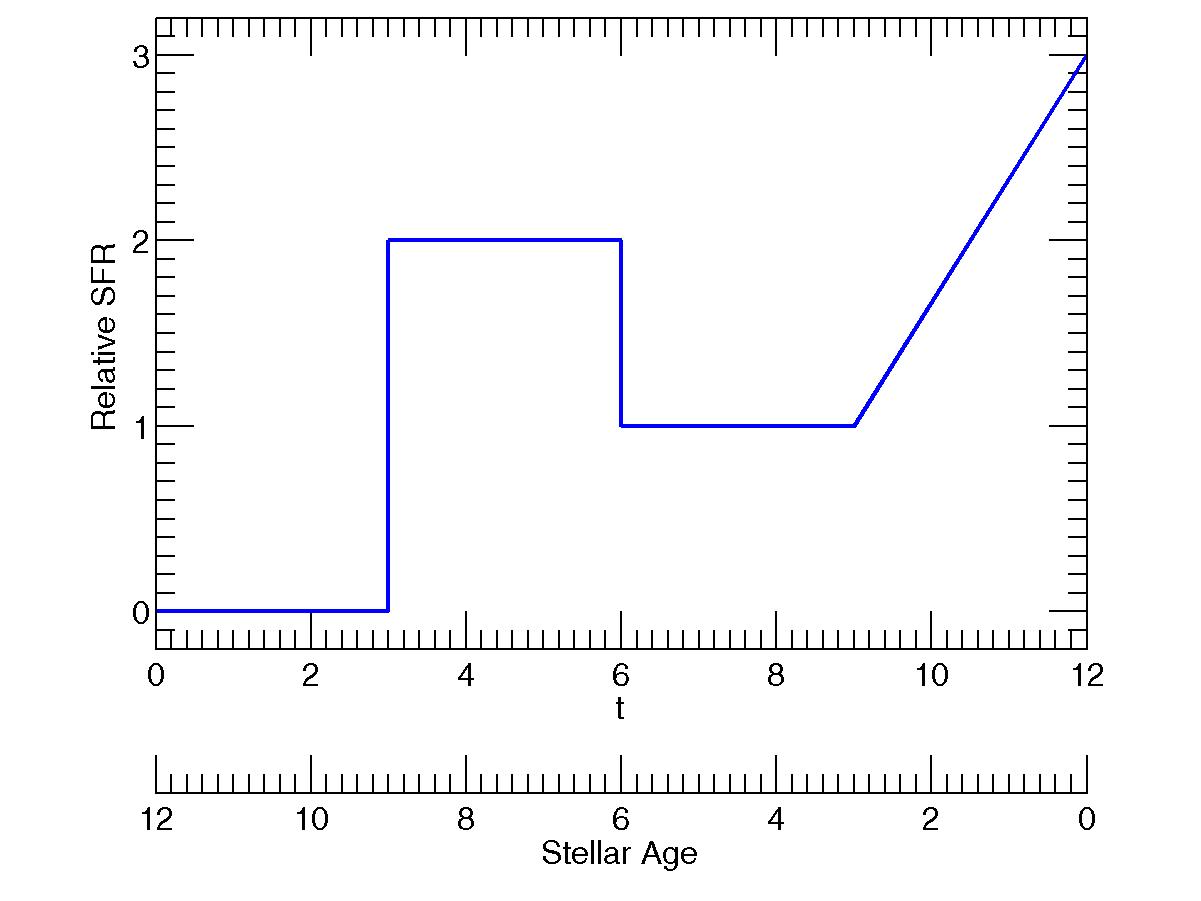
As an example, the following input
list corresponds to the SFR shown in the figure, where t is given in
Gyr:
7, 0, 3, 3, 6, 6, 9, 12, 0, 0, 2, 2, 1, 1, 3
2. Alternatively, the SFR can be given as an exponential function of the form SFR(t)=exp(t/-β). In this case, the format is: 1, T, β. The figure "1" just tells the code that an exponential must be used and T is the present age of the system, in Gyr. In practice, the code makes an equally spaced sampling of 20 points of the exponential and makes linear interpolation between each two. Example: 1, 13, 0.5 would compute SFR(t)=exp(t/-0.5), with present age 13 Gyr.